HealFern may earn a commission if you buy through links on this page, at no extra cost to you. That does not change what we report.
Part of our KeraBiotics overview. Last checked November 5, 2026.
Does KeraBiotics work? There is no published evidence that it does: no trial tests the 15 mL liquid on toenail fungus in people, and its label lists no antifungal drug ingredient[1]. The vendor's reference page cites lab dishes, animal models and microbiome surveys instead[2].
Even proven prescription care is slow: the American Academy of Dermatology (AAD) says a clear nail takes a year or longer to grow out[3].
Does KeraBiotics work? The short answer
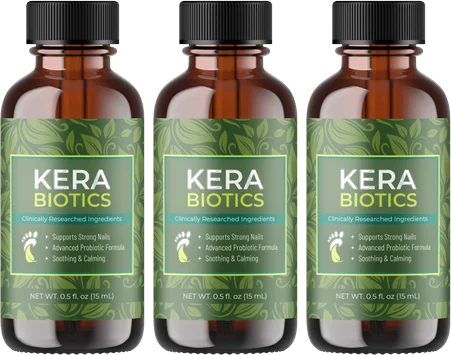
We cannot say it works, because nobody has tested it. What we can say is narrower. The label holds aloe leaf juice, glycerin, cucumber extract, chrysin, three palmitoyl peptides, four probiotic species and copper gluconate, in amounts it does not disclose[1]. None is an antifungal drug.
The peptides, chrysin and topical probiotics have no human trials for nail fungus that we could find. The probiotics sit after the preservatives on the label, with no CFU counts, and the label does not say whether live bacteria survive in the bottle.
What cannot be concluded: that KeraBiotics is useless for every nail problem, since no one has tested it either way. What can be concluded: any benefit for toenail fungus is unproven, and the label itself says "the safety of this product has not been determined"[1].
Which evidence levels should you not confuse?
Four levels of evidence get mixed up in nail fungus marketing. Only the last two can tell you a product works, and KeraBiotics has neither.
Plausibility
Lab studies show some Lactobacillus strains slow Candida yeast in a dish[2]. That makes an idea plausible. It does not show the bacteria survive in a preserved liquid, reach fungus under a hard nail, or act on the dermatophyte fungi behind most toenail infections.
Ingredient trials
Human trials of these probiotic species tested named strains swallowed for gut or mouth health. Chrysin has only oral absorption data in people: after a 400 mg dose, peak blood levels were just 3 to 16 ng/mL[4]. No nail data exist for either.
Finished-product trial
A trial of the actual KeraBiotics formula, against a placebo liquid, with nail lab tests at the end. None has been published.
Replication
A second, independent trial finding the same result. With no first trial, there is nothing to repeat.
KeraBiotics claims vs what the evidence supports
The vendor's main claims go well past its evidence. The table sets each claim beside a fair reading of it and what is missing.
| Vendor claim | Reasonable reading | Limitation |
|---|---|---|
| Formula to "destroy toenail fungus" (contact FAQ) | A disease claim for a cosmetic-style liquid | No antifungal drug on the label; no human trial |
| Good bacteria act against fungus right away (contact FAQ) | Based on lab dish studies | No study on human toenails |
| "Protective shield" against new fungus (contact FAQ) | A claim about stopping new infections | No data of any kind |
| "Clinically Researched Ingredients" (label) | Some species were studied for other uses | No study of this product |
| Ingredients "proven to be safe in clinical trials" (sales FAQ) | Not supported | The label says safety has not been determined |
Claims are from the vendor's contact page and sales page, read November 5, 2026[5][6].
Which ingredients matter most?
The probiotics carry the product's name, so they matter most, and they have the weakest link to nail fungus. The label names four species, Lactobacillus rhamnosus, Lactobacillus paracasei, Bifidobacterium lactis and Lactobacillus acidophilus, but no strain codes and no counts[1].
The National Center for Complementary and Integrative Health (NCCIH) says the effects of one strain do not carry over to another[7]. That means no published trial can be matched to the bottle. The trials that exist also differ on three counts:
- Form: capsules, milk or lozenges swallowed, not a liquid brushed onto skin.
- Dose: about 1 billion to 10 billion CFU a day in gut trials; KeraBiotics lists none.
- Population: people with gut or gum problems, not people with nail fungus.
Chrysin and the three palmitoyl peptides have no nail fungus data in people. Aloe and glycerin are common skin-care base ingredients. Each one is covered in our KeraBiotics ingredients guide.
What results are realistic to expect?
No trial measured KeraBiotics results, so there is no realistic number to give for it. The only timelines with data are for prescription care. The AAD describes daily prescription nail solutions used for about 48 weeks, and oral terbinafine taken for about 12 weeks for toenails[3].
The AAD adds that nail fungus can return after clearing, sometimes a year or more later, and that it takes time to find the right medicine for each patient[3]. A nail grows out slowly, so even a medicine that works shows a clear nail only after many months. Searching for "KeraBiotics best results" will turn up sales copy; it will not turn up a measured outcome.
When should you see a doctor instead?
See a doctor or podiatrist before trying any nail product, because the AAD notes that psoriasis and nail injury can look like fungus[3]. A nail clipping test settles it. See a doctor right away if:
- the skin around the nail is red, warm, swollen or draining pus
- redness spreads up the foot, or you have a fever
- you have diabetes, poor circulation or a weak immune system
- the nail is painful, lifting or bleeding
- several nails change at once, or a dark streak appears
Our guide to toenail fungus remedies lists the options a doctor may offer.
Evidence conclusion
KeraBiotics has not been shown to work on toenail fungus. The table gives our assessment of each question a buyer should ask.
| Decision question | Current assessment |
|---|---|
| Has KeraBiotics been tested in people? | No published trial found |
| Does it contain an antifungal drug? | No, per the label |
| Can the probiotic dose be checked? | No: no strains, no CFU counts |
| Is safety established? | The label says it has not been determined |
| Is there a proven option? | Yes, prescription antifungals after a diagnosis |
Before buying, read KeraBiotics side effects and the refund rules in our price guide. Our methods are on the how we research page.
Back to the KeraBiotics overview.
Frequently asked questions
How long does KeraBiotics take to show results?
No one has measured it, because no trial of KeraBiotics exists. For comparison, the AAD says prescription nail solutions are used daily for about 48 weeks, and a clear toenail takes a year or longer to grow out even when the medicine works.
Is there a clinical trial of KeraBiotics?
We found none. The vendor reference page lists lab, animal and microbiome papers, and none of them tests KeraBiotics or any probiotic applied to toenails in people. The label says Clinically Researched Ingredients, but that does not mean the product was studied.
Do topical probiotics help nail fungus?
There is no human trial showing that. Lab studies show some Lactobacillus strains slow Candida yeast in a dish. Most toenail fungus is caused by dermatophyte fungi, and no study has tested probiotics brushed onto infected nails in people.
What gives the best results for toenail fungus?
Prescription care after a confirmed diagnosis has the data. The AAD lists efinaconazole, tavaborole and ciclopirox solutions and oral terbinafine. The AAD says nail fungus can return after clearing, so follow-up visits matter.
Why does the label say safety has not been determined?
The vendor printed that warning on its own label, read November 5, 2026. It sits beside directions to avoid wounds, damaged or irritated skin, eyes and heating pads. It conflicts with the sales FAQ line that every ingredient was shown safe in clinical trials.
Sources
- KeraBiotics product label. KeraBiotics (vendor), read November 5, 2026.
- References. KeraBiotics (vendor), read November 5, 2026.
- Nail fungus: diagnosis and treatment. American Academy of Dermatology, read November 5, 2026.
- Disposition and metabolism of the flavonoid chrysin in normal volunteers. British Journal of Clinical Pharmacology, PubMed, read October 20, 2026.
- Contact us and FAQ. KeraBiotics (vendor), read November 5, 2026.
- KeraBiotics sales page and FAQ. KeraBiotics (vendor), read November 5, 2026.
- Probiotics: What You Need To Know. National Center for Complementary and Integrative Health, NIH, read October 20, 2026.
This page is general information, not medical advice. Dietary supplements are not reviewed by the FDA for safety or effectiveness before they are sold and are not intended to diagnose, treat, cure or prevent any disease. Talk to your doctor before taking any supplement, especially if you are pregnant, nursing, take medication or have a health condition.